Activated Carbon For Ozone Removal Heycarbons Manufacturer From China
Activated carbon can rapidly decompose dissolved ozone in water into harmless oxygen through catalytic decomposition. It can also adsorb other trace organic matter and odor substances that may be present in the water, thus improving the taste and quality of the water.
Why is Activated Carbon Used For Ozone Removal?
Ozone is a strong oxidant that rapidly kills bacteria, viruses, and mold in water. It is the final disinfection step in drinking water production lines.
Ozone is more effective at disinfection than chlorine, leaves no chemical residue, and produces water with a fresher, more natural taste without the odor of chlorine.
To ensure sterility, manufacturers may add a slightly excessive amount of ozone.
Using activated carbon is a very effective and common treatment method.

Activated Carbon Ozone Removal (Liquid Phase) Adsorption Principle
Does activated carbon remove ozone?
Yes. The main mechanism by which activated carbon removes ozone from the liquid phase is surface catalytic decomposition, rather than simple physical adsorption.
Catalytic Decomposition
The surface of activated carbon contains oxygen-containing functional groups, metallic impurities, and a microporous structure, which can catalyze the decomposition of ozone into oxygen or hydroxyl radicals:
2O₃ → 3O₂
O₃ + H₂O → 2OH + O₂
(OH will continue to oxidize organic matter)
This is the main mechanism, far stronger than simple adsorption.
Physical Adsorption
A small amount of ozone is adsorbed into the porous structure, but because ozone is not easily stabilized, its main function is still catalytic decomposition.
Does ozone react with carbon?
Surface Reaction and Slow Consumption:
What does carbon do to the ozone? During catalytic decomposition, some ozone or intermediate products (such as oxygen free radicals) react with the carbon atoms of the activated carbon itself to produce carbon monoxide (CO) or carbon dioxide (CO₂).
C + O₃ → CO + O₂
C + 2O₃ → CO₂ + 2O₂
This side reaction leads to the slow oxidation of the activated carbon, which will be consumed and deactivated with long-term use.
Activated Carbon For Ozone Removal Process Flow
The diagram below clearly illustrates the typical process flow and core operational steps of using activated carbon to remove ozone from water:
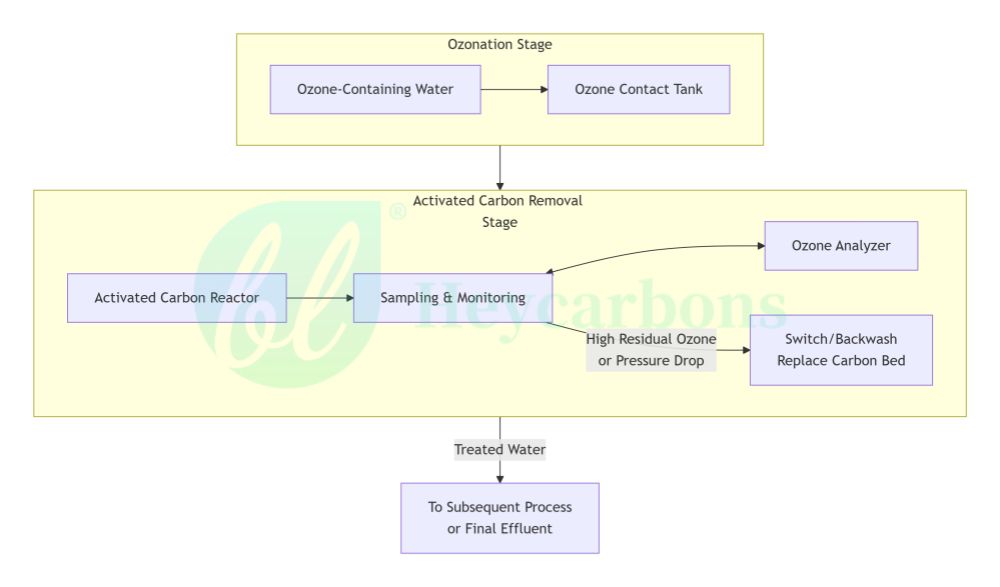
1. Start-up and Operation
Water containing residual ozone from the ozone contact tower enters the reactor from the top.
As the water flows through the activated carbon bed, it undergoes a catalytic decomposition reaction with the activated carbon (2O₃ → 3O₂).
The treated water (with ozone completely removed and converted into oxygen) flows out from the bottom of the reactor and enters the subsequent unit.
During this stage, the residual ozone concentration in the effluent and the bed pressure drop need to be continuously monitored.
2. Subsequent Fine Filtration
This is the “safety lock” of the entire process. After passing through the activated carbon tank, the water immediately passes through a sterilization-grade filter cartridge with an absolute precision of 0.2 or 0.45 microns.
This filter cartridge acts as the final microbial barrier, trapping any tiny carbon particles that might detach from the activated carbon, ensuring the sterility of the water.
3. Backwashing (Critical Maintenance Step)
Operation: Periodically (e.g., every 24-48 hours), backwash the reactor from the bottom with clean water (usually treated or filtered water) at a high flow rate. This loosens and expands the activated carbon bed, allowing contaminants to drain from the top drain valve.
Purpose: To flush away suspended solids and carbon fragments trapped in the activated carbon layer, alleviate bed clogging, and restructure the bed.
Note: Backwashing only removes physical blockages and cannot restore activated carbon lost due to chemical oxidation.
4. Activated Carbon Replacement
Activated carbon needs to be replaced when the following conditions occur:
- Excessive ozone concentration in the effluent: Even with extended contact time, the ozone concentration in the effluent fails to drop below the target value, indicating a loss of catalytic activity.
- Sustained high pressure drop: Even after backwashing, the pressure drop rises rapidly, indicating severe breakage and caking of the activated carbon bed due to oxidation consumption.
- Activated carbon bed loss: Regular inspections reveal a significant reduction in the thickness of the activated carbon bed.
Replacement procedure: Open the manhole, remove the expired activated carbon, clean the reactor, and then refill with new activated carbon.
Activated Carbon For Ozone Removal Affecting Factors
Ozone Removal Activated Carbon Properties
Specific surface area and pore structure: Provides more reaction sites. Mesopores (2-50 nm) are particularly important for the transport of larger molecules in the liquid phase.
Surface chemistry: Activated carbons with more oxygen-containing functional groups and basic groups generally have higher catalytic activity for ozone decomposition.
Water Quality Conditions
Water Temperature: Increased temperature accelerates the chemical reaction rate. Therefore, within a certain range, higher temperature increases ozone removal efficiency, but also accelerates activated carbon consumption.
pH: Activated carbon is more efficient at catalytically decomposing ozone under neutral to slightly alkaline conditions.
Organic Matter Content: If other organic matter in the water is present and can be oxidized by ozone, it will compete with activated carbon for ozone, thus reducing the effective ozone removal capacity of the activated carbon.
Operating Parameters
Empty bed contact time EBCT: The contact time between the water flow and activated carbon must be long enough to ensure complete ozone decomposition. EBCT (Effective Embedded Flow Rate Contact Time) is typically designed to be within a few minutes, but the specific time needs to be determined based on the influent ozone concentration and flow rate.
Ozone concentration: The higher the concentration, the faster the activated carbon is consumed, and the shorter the replacement cycle.
Flow rate: Excessively high flow rates will shorten the EBCT and may cause ozone to penetrate the activated carbon bed without being completely removed.
Heycarbons Activated Carbon Ozone Removal Products
Both coal-based activated carbon and coconut shell granular activated carbon can be used to remove ozone from water. Below are some activated carbon types commonly chosen by our customers. Heycarbons can also customize activated carbon to your specific needs.
Reagglomerated Briquetted Activated Carbon For Ozone Removal O3
HEYSORBCARB®-HEYBGAC
- Iodine value: 500-1100 mg/g
- Methylene blue: 120-240 mg/g
- Molasses value: 180-300
- Specific surface area: 500-1050 m2/g
- Hardness: 90-99%
- Bulk density: 0.45-0.55 g/cm3
- Ash:6-8, 8-12, 12-15%
- Moisture: 5% max.
- pH: 8-11

Bituminous Coal Granular Activated Carbon For O3 Ozone Removal
HEYSORBCARB®-HEYGAC
- Iodine value: 500-1100 mg/g
- Specific surface area: 500-1050 m2/g
- Hardness: 90-99%
- Bulk density: 0.45-0.55 g/cm3
- Ash: 6-8, 8-12, 12-15%
- Moisture: 5% max.
- pH: 8-11
Heycarbons Coal Activated Carbon

Coconut Nutshell Granular Activated Carbon Ozone Removal
HEYSORBCARB®-HEYCCGAC/NCGAC
- Size: Mesh 4*8, 8*30, 8*16, 12*40, 30*60, 80*150
- Iodine value: Mg/g 700-1700
- Hardness %: 95-99.8
- Bulk density g/cm3 0.45-0.55
- Ash %: 2-4
- Moisture %: 5max
- PH: 8-11
Heycarbons Coconut Nutshell Activated Carbon
https://heycarbons.com/coconut-shell-activated-carbon/

Acid-washed Activated Carbon For Ozone Removal
Coal-based, coconut shell and nutshell activated carbon can all be acid-washed. The choice depends on the customer’s application and requirements.
Its advantages lie in its low ash content and neutral pH.
HEYSORBCARB®-HEYAGAC/ACCGAC
- Size: 4-8, 8-30, 30-60, 50-120, 80-150, 200, 325 mesh
- Iodine value: 800-1200 mg/g
- methylene blue: 120-180 mg/g
- Bulk density: 0.4-0.5 g/cm3
- Ash (coconut): 1% max.
- Ash (nutshell): 1.5%, 2% max.
- Ash (coal): 3% max.
- pH: 6-8
Heycarbons Acid-washed Activated Carbon
Catalytic Activated Carbon Or Not?
Some customers have requested that activated carbon be used as a catalyst carrier to support metal oxides (MnO2/Fe2O3), but Heycarbons does not recommend this. Reasons:
- A small amount of metal ions may dissolve into the water.
- Ordinary granular activated carbon (especially high-quality coconut shell GAC) with a high specific surface area and abundant oxygen-containing functional groups on its surface already has a significant catalytic effect on ozone decomposition, and there is no need to add additional metal support.
Activated Carbon For Ozone Removal Customer Case
A Thai customer needed activated carbon to remove bromate (an ozone byproduct, a carcinogen) from a water treatment plant. Heycarbons provided the customer with two sizes of briquetted activated carbon with an iodine value of 950mg/g: 8*12 mesh and 8*30 mesh.
The customer ultimately chose the briquetted activated carbon of 8*12 mesh. In fact, bituminous coal granular activated carbon can also be used.
If you also need to use activated carbon to remove dissolved ozone from water, please click the link below to contact Heycarbons. We will provide you with professional advice and high-quality activated carbon products.
Activated Carbon for Ozone Removal in Gas Phase
Besides the liquid phase, activated carbon can also be used for ozone generation in the gas phase. See details below.
https://heycarbons.com/activated-carbon-for-ozone-removal-from-gas/
Custom Heycarbons Activated Carbon Ozone Removal O3
Heycarbons provides a full range of activated solutions at competitive prices.

Custom Heycarbons Activated Carbon For Your Business
Heycarbons has proudly served the activated carbon industry with high-quality products since 2005, we can customize your activated carbon for your project.
- Personalized service and advice based on your needs and preferences. Different raw materials for different applications.
- Customized size, iodine value , methylene blue, PH, ash, etc. Also acid washing.
- Heycarbons customized package to promote your brand, and free design service.
Call Us
+86-180 3788 5195
Our Email
info@heycarbons.com
Steps to Custom Heycarbons Ozone Removal Activated Carbon
Consultation
By understanding your needs and requirements, our salesmen work with you to submit the appropriate activated carbon solution.
Quotation
Heycarbons expert customer service will provide you with a free quote based on your requirements as well as product specifications and quantities.
Production
Heycarbons has sufficient inventory and strong production capacity, and will report production progress to you from time to time.
Shipping
Heycarb know you need to receive the product as soon as possible, after rigorous quality checks and protective packaging, by fedex shipping.

Are You Looking for Heycarbons Activated Carbon Manufacturers?
Contact us for design assistance, free quote, and expert advice today.
Your inquiry will be replied within 24 working hours, and Heycarbons respect your privacy.