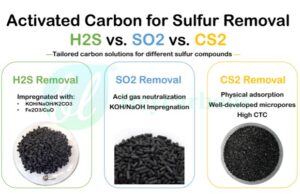
In the field of industrial waste gas treatment, sulfides are among the most common and challenging pollutants. Although H2S, SO2, and CS2 are all sulfur-containing gases, their molecular polarity, adsorption mechanisms, and reaction pathways are completely different, leading to significant differences in their treatment strategies using activated carbon.
If the gas is reactive (e.g., H2S, SO2), impregnated activated carbon can be selected. If the gas is non-polar (such as CS2), high CTC activated carbon can be used.
You can also click to learn more about impregnated carbon products and their applications in desulfurization:
https://heycarbons.com/impregnated-activated-carbon/
This article will systematically analyze the differences in the application of activated carbon in desulfurization from the perspectives of reaction mechanism, activated carbon selection, and process conditions.
Activated Carbon for H2S Removal
The small molecular weight and weak polarity of H₂S limit the physical adsorption capacity of activated carbon.
However, H2S has high chemical reactivity and is easily oxidized. It can react with alkaline substances or metal oxides to form elemental sulfur (S) or sulfates, thereby achieving the purpose of removing H2S.
Customers can choose between non-impregnated activated carbon for physical adsorption or impregnated carbon (physical adsorption plus chemical reaction) according to their own needs.
Non-impregnated ordinary activated carbon has a low working sulfur capacity, while its working sulfur capacity can be significantly improved through impregnation or catalytic modification.
Which Activated Carbon is Best for H₂S Removal?
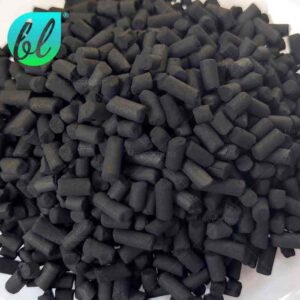
Heycarbons offers coal-based columnar activated carbon specifically designed for H2S removal. The specifications for non-impregnated activated carbon are as follows:
| Project | Parameter |
|---|---|
| Size | 0.9/1.5/2/3/4/5/6/7 mm |
| Iodine value | 900-1150 mg/g |
| CTC | ≥40-90 |
| Bulk density | 0.45–0.55 g/cm3 |
| Strength | ≥95% |
| Ash content | ≤8–15%(The ash will change after impregnation.) |
| Moisture content | ≤5% |
| pH | 8-11(The pH will change after impregnation.) |
Depending on the customer’s operating conditions, the impregnation can be done using alkaline substances such as KOH/K₂CO₃/NaOH or metal oxides such as Fe₂O₃/CuO.
KOH offers high cost-effectiveness but has a low ignition point. If the customer has specific ignition point requirements, NaOH or K₂CO₃ can be considered.
Metal oxide-impregnated carbon primarily relies on chemical reactions to remove H₂S, offering higher stability and resistance to humidity fluctuations, but at a relatively higher cost.
Reaction Process of Activated Carbon for H2S Removal
The removal of hydrogen sulfide utilizes the catalytic reaction of H2S with oxygen to remove H2S. The sulfur formed in the reaction is deposited inside the pores of activated carbon: 2H2S + O2 → 2H2O + 2S + 106 kcal. The specific process is as follows:
1. Water in the gas is adsorbed onto the activated carbon and forms a water film on its surface.
2. Hydrogen sulfide and oxygen diffuse into the pores of the activated carbon. Hydrogen sulfide decomposes within the water film, and oxygen molecules are also adsorbed and activated on the surface of the activated carbon, reacting with HS-.
HS- reacts with oxygen to produce elemental sulfur: HS⁻ + ½O₂ → S↓ + OH⁻
3. The active oxygen atoms generated by the breaking of the O-O bond also quickly participate in the reaction, and the generated sulfur gradually deposits on the activated carbon, thus achieving the removal of H2S.
Activated Carbon for H2S Removal Process Conditions
In industrial applications, we have observed that activated carbon’s ability to remove H2S is subject to humidity requirements. The impregnating material reacts chemically with H2S, requiring the participation of H2O and O2. The optimal humidity is 40–80% RH. It hardly reacts under dry gas conditions, while excessive humidity can easily cause pore blockage.
Different impregnating materials have different requirements for the working environment. Heycarbons can recommend the most suitable impregnating carbon based on your application scenario and working environment. Contact us now!
To learn more about activated carbon for H2S removal, please visit:
https://heycarbons.com/activated-carbon-for-h2s-removal/
Heycarbons not only provides customers with detailed product advice/consultation but also offers suggestions on usage quantities and adsorption bed design.

Activated Carbon for SO2 Removal
Which Carbon should be Used for SO₂ Removal in Gas Streams?
SO2 is a toxic gas emitted into the atmosphere by industry, primarily from coal-fired power plants, ferrous and non-ferrous metallurgical industries, chemical (mainly sulfuric acid plants), and petroleum processing industries. Sulfur contained in fuels and metal ores primarily produces SO2 during combustion or processing.
In highly industrialized countries, the United States alone emits tens of millions of tons of SO2 into the atmosphere annually. Its recovery not only addresses atmospheric ecological issues but also has economic value.
Among the various methods for recovering and neutralizing SO2, activated carbon adsorption plays a significant role. Typically, the adsorption of SO2 on activated carbon is accompanied by catalytic oxidation to SO3, subsequently forming H2SO4 (in the presence of water).
SO2 is a strongly polar acidic gas that is very soluble in water. Removal of SO2 mainly relies on alkaline neutralization and oxidation reactions. A typical reaction process is SO₂ + H₂O + ½O₂ → H₂SO₄
Activated Carbon Product for SO2 Removal
Heycarbons offers high-strength coal-based columnar activated carbon specifically designed for SO2 removal. The base carbon parameters before impregnation are as follows:
| Project | Parameter |
|---|---|
| Size | 0.9-8 mm(4mm is usually chosen} |
| Iodine value | 900-1150 mg/g |
| CTC | ≥40-90 |
| Bulk density | 0.45–0.55 g/cm3 |
| Strength | ≥95% |
| Ash content | ≤8–15% |
| Moisture content | ≤5% |
| pH | 8-11 |
The impregnation chemicals can be selected according to customer needs. Impregnation with alkaline compounds (such as KOH, NaOH, K₂CO₃, KOH+KI, etc.) is less expensive and can react with SO₂ to form sulfates, thereby improving the activated carbon’s adsorption capacity for SO₂.
Impregnation with metal oxides, such as CuO and MgO, is slightly more expensive and can catalyze the oxidation reaction of SO₂, thus improving adsorption efficiency.
A customer tested and compared CuO, KOH+KI, and NaOH-impregnated carbon. The results showed that KOH+KI impregnation resulted in the highest working sulfur capacity. Taking into account both adsorption capacity and cost, 6-8% NaOH is the most cost-effective option. For detailed experimental data, please contact Heycarbons.
Besides coal-based extruded carbon, some customers also purchase coconut shell granular impregnated activated carbon (30*60 mesh) from Heycarbons for SO2 removal. For the related customer case study, please visit:
https://heycarbons.com/impregnated-activated-carbon-for-so2/
Reaction Process of Activated Carbon for SO2 Removal
In the chemical reaction of KOH impregnation for SO2 adsorption in coal-derived columnar activated carbon, KOH reacts with SO2 to produce potassium sulfate (K2SO4) and water (H2O). The specific chemical formulas are as follows:
1. Reaction of KOH with SO2:
2KOH + SO2 → K2SO3 + H2O
This step involves the reaction of KOH with SO2 to form potassium sulfite (K2SO3) and water.
2. Further oxidation of potassium sulfite:
If oxygen (O2) is present, potassium sulfite (K2SO3) can be further oxidized to potassium sulfate (K2SO4), as shown in the following reaction:
2K2SO3 + O2 → 2K2SO4
– In KOH-impregnated activated carbon, KOH first reacts with SO2 to produce K2SO3 and water.
– Then, in the presence of oxygen, K2SO3 can be further oxidized to K2SO4.
In this way, activated carbon not only plays an adsorption role, but also participates in the chemical reaction to convert SO2 into solid sulfides, thereby achieving the removal of SO2.
Activated Carbon for SO2 Removal Process Conditions
In industrial applications, we have found that the removal efficiency of activated carbon for sulfur dioxide (SO₂) is significantly affected by operating conditions. The impregnating material reacts chemically with SO2, requiring oxidation catalysis from H2O and O2. The ambient humidity must be >50% RH, with 60–80% being optimal. Under dry gas conditions, the reaction rate is low, while moderate humidity promotes SO₂ adsorption and conversion; however, excessive humidity can cause pore blockage and reduce adsorption efficiency.
Furthermore, factors such as temperature and gas composition also affect the performance of different impregnated materials. Heycarbons can recommend the most suitable impregnated activated carbon products based on your specific operating conditions and environment. Contact us now!
Activated Carbon for CS2 Removal
CS2 is a nonpolar small molecule and exhibits low reactivity at room temperature and pressure. Activated carbon removal of CS2 primarily relies on physical adsorption, typically requiring activated carbon with high micropore volume and suitable pore size distribution (usually characterized by a high CTC value), and is more sensitive to operating conditions (such as temperature, humidity, and contact time).
Activated Carbon Product for CS2 Removal
Heycarbons offers coconut shell granular activated carbon and high-CTC coal-based columnar activated carbon specifically designed for CS₂ removal.
What is the best activated carbon for CS2 removal? CS2 is a nonpolar small molecule that is not adsorbed by surface functional groups and has weak intermolecular forces, thus requiring coconut shell activated carbon of well-developed micropores. It has a stronger adsorption capacity than coal activated carbon with more mesopores, making it a more recommended adsorption material.
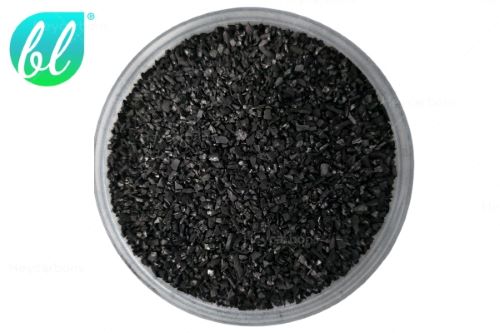
Coconut shell activated carbon parameter for CS₂ removal is as follows:
| Project | Parameter |
|---|---|
| Size | 4-8, 8-30 mesh |
| Iodine value | 900-1200 mg/g |
| CTC | ≥50-85 |
| Bulk density | 0.45–0.52 g/cm3 |
| Strength | ≥95% |
| Ash content | ≤3-5% |
| Moisture content | ≤5% |
Bituminous coal activated carbon parameter for CS2 removal is as follows:
| Project | Parameter |
|---|---|
| Size | 2-4 mm |
| Iodine value | 900-1150 mg/g |
| CTC | ≥50-90 |
| Bulk density | 0.45–0.52 g/cm3 |
| Strength | ≥95% |
| Ash content | ≤8-10% |
| Moisture content | ≤5% |
Bituminous coal activated carbon can be used as a cost-effective alternative for CS₂ removal, but its adsorption capacity is lower than that of coconut shell activated carbon due to its slightly lower micropore ratio.
Why impregnated carbon is not suitable for CS2? Impregnation chemicals may clog micropores. Impregnated activated carbon is not suitable for CS₂ removal.
Activated Carbon for CS2 Removal Process Conditions
In industrial applications, the removal efficiency of activated carbon for carbon disulfide (CS₂) is highly sensitive to operating conditions. Generally, lower temperatures are more conducive to adsorption, with the optimal operating temperature being 20–30°C.
Furthermore, unlike impregnated carbon for H₂S and SO2 removal, which requires maintaining certain humidity levels, activated carbon for CS₂ removal should maintain as low a humidity level as possible (<30-50%) to avoid competition for adsorption sites and porosity effects from moisture.
For gas treatment applications, Heycarbons not only provides customers with professional product selection and technical consultation but also offers optimized usage suggestions and adsorption bed design solutions based on specific operating conditions, helping to achieve more efficient and stable operation while reducing overall operating costs.
FAQ of Activated Carbon for H2S vs SO2 vs CS2 Removal
Q1: Does humidity affect SO2 removal?
A1: Yes, during this process, humidity must be >50% RH, with 60–80% being optimal. Insufficient humidity will almost halt the reaction, while excessive humidity will cause sulfur deposition and water blockage of the pores. During the SO2 removal process, the humidity is adjusted according to the specific operating conditions.
Q2: Why impregnated carbon is not suitable for CS₂?
A2: CS2 is a nonpolar small molecule with low chemical reactivity. CS2 removal mainly relies on physical adsorption rather than chemical reaction. Furthermore, the small size of CS2 molecules necessitates the use of coconut shell charcoal with well-developed micropores; impregnation with chemicals may clog the micropores.
Q3: Why is CS₂ harder to remove than H₂S?
A3: H2S is easier to remove because it is a polar molecule that readily reacts chemically with impregnable activated carbon, resulting in higher removal efficiency and breakthrough capacity. In contrast, CS2 has lower reactivity at room temperature and pressure, making it difficult to react with impregnating agents and relying mainly on physical adsorption, thus making it more difficult to capture. High-CTC microporous carbon is typically required. Unlike H2S and SO2, CS2 does not require H2O and O2 to react. Lower humidity is better.