Platinum On Carbon Catalyst - Heycarbons Supplier From China
Table of Contents
- What is Platinum On Carbon Catalyst?
- Heycarbons Platinum On Carbon Catalyst Product
- How Does Pt Catalytic Activated Carbon Work?
- Heycarbons Platinum On Carbon Catalyst Features
- Platinum Catalyst Activated Carbon Uses
- Pt Catalytic Carbon Production Process
What is Platinum On Carbon Catalyst?
Platinum on carbon catalyst, also known as Pt catalytic activated carbon, is a noble metal catalytic material with platinum as the active component and activated carbon as the support.
Platinum (Pt) is a noble metal catalyst with extremely high catalytic activity and good chemical stability. It can promote reactions without undergoing transformation and has multiple functions, including catalytic oxidation of organic matter, hydrogenation, dehydrogenation, and ozone decomposition.
Activated carbon has a high specific surface area and porous structure, which can disperse and immobilize Pt particles, making it easier for pollutants to contact the active sites of Pt and improving catalytic efficiency.
The following section focuses on platinum catalytic activated carbon. More detailed information about catalytic activated carbon, please click and visit: https://heycarbons.com/catalytic-activated-carbon/
Heycarbons Platinum On Carbon Catalyst Product
Heycarbons Pt catalytic activated carbon generally uses acid-washed high-purity activated carbon as the base carbon, with low ash content and few metal impurities. Its well-developed micropores facilitate uniform Pt dispersion, enhancing the VOC and CO enrichment capabilities. It also has high strength and is not easily pulverized.
The specification of Heycarbons Pt catalytic activated carbon is as follows:

| Project | Specification |
|---|---|
| Type | Coconut shell activated carbon |
| Size | Pellet 1.5/2/3/4 mm; Granule 8-30, 12-40, 20-50 mesh; Powder 200, 325 mesh |
| Ash | <3% (after acid washing <1-2%) |
| CTC | 50-60 |
| Hardness | 95-99.8% |
In addition to pelletized activated carbon, Heycarbons also offers Pt catalytic powdered activated carbon and granular activated carbon, all of which can be customized to meet customer applications and project designs.
Pt catalytic granular carbon (12-40, 20-50 mesh) has small particles and fast mass transfer, but high pressure drop, making it suitable for high-end gas purification applications such as semiconductors, laboratories, precision air purification, VOC purification, CO removal, and ozone decomposition.
While there is some overlap in the applications of coconut shell pelletized and granular activated carbon, they are optimized for different system requirements. Granular activated carbon has higher catalytic efficiency and faster mass transfer rate, making it suitable for high-end polishing; while pelletized activated carbon has lower pressure drop and better long-term mechanical stability, making it suitable for continuous gas phase systems.
Powdered Pt-loaded coconut shell activated carbon has the largest surface area, the most Pt exposure, and the fastest reaction, making it suitable for chemical catalytic reactions in fields such as hydrodehydrogenation, pharmaceutical intermediates, and fine chemicals.
Heycarbons manufactures a wide variety of catalytic activated carbon. High-performance activated carbon solutions can be customized. Please contact us for platinum catalyst and information.
How Does Pt Catalytic Activated Carbon Work?
Pt catalytic activated carbon combines the porous structure of activated carbon with the catalytic function of precious metals. While adsorbing pollutants, it primarily relies on the supported Pt for catalytic decomposition.
Below is a detailed explanation of the working process of Pt catalytic carbon.
Activated Carbon Adsorption
The gases that need to be treated (such as VOCs, CO, formaldehyde, methanol, and ozone) enter the pores of the activated carbon, are enriched by the pore structure, and approach the active sites of Pt.
Pt Catalytic Oxidation Mechanism
Pt provides highly active catalytic sites, enabling the activation of oxygen at lower temperatures and reducing the activation energy of the reaction, thereby promoting the oxidation or decomposition of pollutants.
The pathway by which Pt participates in catalytic reactions varies depending on the pollutant. Below are three typical platinum catalyst formula reactions:
1. CO Oxidation
2CO + O2 → 2CO2
Pt can rapidly oxidize carbon monoxide to carbon dioxide, which is one of the most classic applications of platinum on carbon catalysts.
2. VOC Oxidation (using methanol as an example)
2CH3OH + 3O2 → 2CO2 + 4H2O
Pt can promote the deep oxidation of VOCs at low temperatures, converting them into CO2 and H2O.
3. Ozone Decomposition
2O3 → 3O2
Pt can catalyze the rapid decomposition of ozone into oxygen, reducing ozone concentration and its oxidizing and corrosive properties.
Heycarbons Platinum On Carbon Catalyst Features
Thanks to Heycarbons precisely controlled and mature preparation process (which will be detailed later), Pt catalytic activated carbon exhibits excellent performance. Specifically, it’s mainly reflected in the following aspects:
Advantages of Pt Catalytic Activated Carbon
- After adsorption and catalytic decomposition, Pt catalytic activated carbon releases active sites, allowing it to continue catalytic oxidation and exhibiting a certain degree of self-regeneration capability. It also has a long service life.
- Efficiently remove pollutants at room temperature or lower.
- High removal efficiency for pollutants at the ppm/ppb level.
- The synergistic effect of adsorption and catalytic oxidation improves stability.
Disadvantages of Pt Catalytic Activated Carbon
- Pt is expensive and unsuitable for high-flow-rate systems.
- There is a risk of sulfur poisoning: Due to the extremely strong binding between S and Pt, a strong coordination similar to Pt−S is formed, causing Pt sites to be permanently occupied, directly stopping the catalytic reaction. If H2S, SO2, organic sulfur, or thiols are present in the air, they will adhere to the Pt surface, leading to Pt poisoning and preventing catalytic reactions. Therefore, Pt is generally not used in high-sulfur environments.
Platinum Catalyst Activated Carbon Uses
Platinum On Carbon Catalyst can be used for catalytic oxidation of VOCs, removal of CO, decomposition of ozone, dehydrogenation and hydrogenation at lower temperatures or room temperature. And it’s suitable for high-end fields such as electronics, pharmaceuticals, laboratories, and medical air purification.
VOC Catalytic Oxidation
Platinum-supported catalytic carbon is suitable for the catalytic oxidation treatment of low-concentration VOCs in waste gas. It can efficiently convert organic pollutants into CO2 and H2O at relatively low temperatures. It is suitable for organic waste gases such as methanol, toluene, aldehydes, ketones, and benzene compounds.
Low-Temperature CO Removal
At room temperature, Pt can rapidly oxidize carbon monoxide to carbon dioxide: 2CO + O2 → 2CO2
This is particularly suitable for laboratory exhaust, precision instrument exhaust, air purification in confined spaces, and semiconductor clean air systems.
Ozone Decomposition
Pt catalytic activated carbon can efficiently decompose ozone, rapidly converting O3 into oxygen through catalytic reaction (2O3→3O2). This effectively reduces the impact of residual ozone on humans and equipment. It is widely used in bottled water production, RO pure water post-treatment, high-end drinking water purification, medical air systems, and semiconductor clean air systems.
Platinum Catalyst for Hydrogenation/Dehydrogenation
Platinum, as the main catalytically active component, provides excellent catalytic activity and selectivity in selective hydrogenation, dehydrogenation, and hydrogenolysis reactions.
Pt catalytic activated carbon can be used as fuel cell catalyst support and is also widely used in the synthesis processes of fine chemicals, pharmaceutical intermediates, and specialty organic compounds.
In addition, Heycarbons can offer competitive prices without compromising the quality and performance of platinum on carbon catalyst. Contact us for the latest quote.
Pt Catalytic Carbon Production Process
How is Pt impregnated onto activated carbon? It’s not simply coated on. Instead, activated carbon is impregnated with chloroplatinic acid (H2PtCl6) through a chemical method. Then it’s reduced to Pt nanoparticles and fixed in the porous structure.
1. Pretreatment
First, the activated carbon is cleaned to remove dust. Then, acid washing is used to reduce metallic impurities (Fe/Ca/Na) while increasing surface oxygen-containing functional groups (–OH/–COOH). This makes it easier for the Pt precursor to adhere.
2. Impregnation
Activated carbon is wetted with a solution containing Pt ions (Heycarbons uses chloroplatinic acid H2PtCl6), allowing the Pt precursor to enter the pores and adsorb onto the carbon surface.
Industrially, there are two main methods: equal-volume impregnation and excess impregnation.
Incipient Wetness Impregnation (commonly used by Heycarbons)
First, measure the pore volume of the activated carbon. Then, precisely add just enough chloroplatinic acid (H2PtCl6) solution to be absorbed by the carbon, without overflowing. PtCl₆²⁻ will enter the micropores and mesopores through capillary action, electrostatic adsorption, and coordination with surface functional groups.
Heycarbons commonly use the incipient wetness impregnation method. It ensures uniform Pt distribution and is suitable for high loading. Another method is over-impregnation (soaking).
Over-impregnation (Soaking)
Over-impregnation involves directly immersing the activated carbon in a large amount of chloroplatinic acid (H2PtCl6) solution. This method is simple to operate and provides good dispersion, but it results in significant loss of Pt salt solution, and the waste liquid requires the recovery of precious metals. Soaking is generally not recommended.
3. Drying
The chloroplatinic acid H2PtCl6 is already distributed in the pores of the activated carbon, but it is not yet metallic Pt. Next, it is dried at 100-120°C to evaporate moisture and fix the platinum salt onto the pore walls.
4. Reduction: Platinum Salt → Pt Nanoparticles
Heycarbons uses hydrogen to reduce the platinum salt into nanoscale Pt particles. In an H₂ environment and heating at 150–300°C, Pt ions are reduced to metallic Pt nanoparticles, which are then anchored on the activated carbon surface. The core chemical reaction is PtCl₆²⁻ + H₂ → Pt + HCl. Byproducts are mainly HCl, water, and volatile gases, with very little residual organic matter. The Pt surface is clean and highly active.
Finally, the Pt nanoparticles are uniformly dispersed on the pore walls of the activated carbon, with some entering the micropores.
Custom Heycarbons Pt Catalytic Activated Carbon
Heycarbons provides a full range of activated solutions at competitive prices.
Custom Premium Pt Catalytic Activated Carbon from China
Heycarbons has been committed to providing high-quality Pt catalytic activated carbon since 2005. Heycarbons can customize catalytic activated carbon solutions for your project.
- Customized size, iodine value, ash, methylene blue, moisture, specific surface area, etc.
- Heycarbons customized package to promote your brand, and free design service.
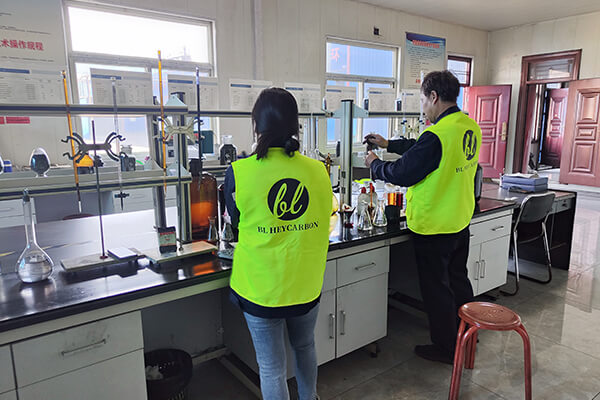
- Each batch of activated carbon undergoes multiple mixing tests to ensure quality. It also supports any form of third-party testing for customers.
Call Us
+86-180 3788 5195
Our Email
info@heycarbons.com
Reliable carbon from China, with confidence — Choose Heycarbons
Steps to Custom Heycarbons Pt Catalytic Activated Carbon
Consultation
By understanding your needs and requirements, our salesmen work with you to submit the appropriate activated carbon solution.
Quotation
Heycarbons expert customer service will provide you with a free quote based on your requirements as well as product specifications and quantities.
Production
Heycarbons has sufficient inventory and strong production capacity, and will report production progress to you from time to time.
Shipping
Heycarbons know you need to receive the product as soon as possible, after rigorous quality checks and protective packaging, by fedex shipping.



Are You Looking for Pt Catalytic Activated Carbon Supplier in China?
Contact us for design assistance, free quote, and expert advice today.
Your inquiry will be replied within 24 working hours, and Heycarbons respect your privacy.